
Social Security Antigua: Your Complete 2026 ABSSB Guide
The Antigua and Barbuda Social Security Board (ABSSB) provides six core benefits: sickness, maternity, invalidity, age pension, survivors, and funeral grant. As of 2025, the pensionable age is 65 and contribution rates are capped at 16% for private sector workers. This guide covers every benefit, every rate, and exactly how to claim — in plain English.
Social Security Antigua: Your Complete 2026 ABSSB Guide
TL;DR: The Antigua and Barbuda Social Security Board (ABSSB) provides six core benefits: sickness, maternity, invalidity, age pension, survivors, and funeral grant. As of 2025, the pensionable age is 65 and contribution rates are capped at 16% for private sector workers. This guide covers every benefit, every rate, and exactly how to claim — in plain English.
Every working person in Antigua and Barbuda contributes to social security. But most people have no idea what they're entitled to until they actually need it. The official ABSSB website is packed with forms and legal language. Finding a clear, plain-English answer takes far too long.
This guide fixes that.
Whether you're a local employee, a self-employed vendor setting up during Carnival season, an expat on the Nomad Digital Residence visa, or a returning member of the Antiguan diaspora from Canada, this is the only 2026 resource you need. We break down contribution rates, all six benefit types, how to claim each one, and the bilateral Canada-Antigua agreement that many returning residents don't know exists.
Bookmark it. Share it with your employer. Come back to it when you need it.
What Is Antigua's Social Security System and Who Runs It?
The Antigua and Barbuda Social Security Board (ABSSB) is the government body that collects contributions and pays out cash benefits to qualifying contributors. It's been doing this since April 2, 1973, making Antigua the first OECS nation to introduce a full social security system.
The ABSSB operates under the Social Security Act of 1972 and falls under the Ministry of Finance and Corporate Governance. Its mandate covers six types of cash benefits: sickness, maternity, invalidity, age pension, survivors, and funeral grant.
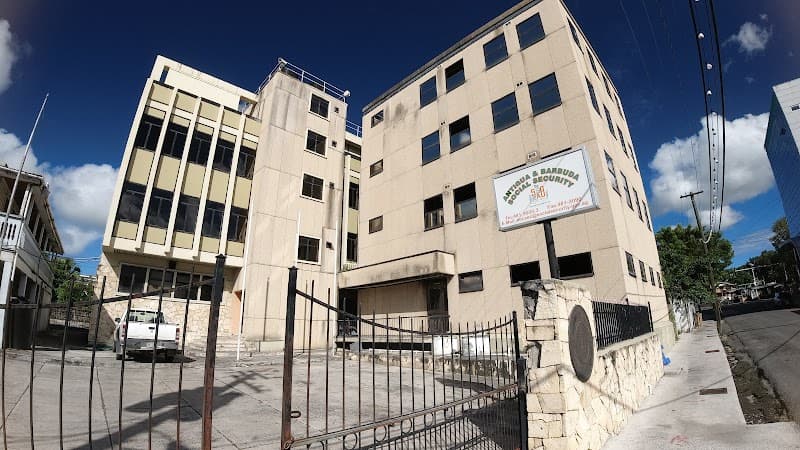
You'll find the ABSSB's main office on Long Street in St. John's. It's also listed directly in the AntiguaSearch government services directory, where you can find the address, contact details, and directions.
The system is designed around one simple idea. You contribute while you work. You claim when you need it. Coverage follows you from job to job, and your credits are fully portable across every employer you ever work for.
What Are the 2026 Contribution Rates?
As of January 1, 2025, Antigua's social security contribution rates reached their final, legislated level. No further increases are planned. For 2026, these rates remain in force.
Here's the breakdown by sector:
Private sector workers: 16% of insurable earnings total. Employees contribute approximately 6.5% and employers cover approximately 9.5%. This applies to all private companies, tourism businesses, restaurants, hotels, and self-employed contractors registered under the private sector scheme.
Public sector workers: 15% of insurable earnings total. The employee portion is 6% and the employer (government) portion is 9%.
Self-employed persons: A flat rate of 10% of monthly covered earnings, paid directly to the ABSSB each month.
The maximum insurable earnings ceiling is EC$6,500 per month. That means contributions are only calculated on earnings up to that ceiling, even if your actual salary is higher. The minimum earnings used to calculate contributions align with the legal monthly minimum wage.
Contributions are due within 14 days after the end of each month. Late payments attract a 10% surcharge on the total amount owed. Employers who file incomplete or incorrect contribution forms (the R5A) are fined EC$100 per incorrect page.
One important note: contributions are not deducted while an employee is receiving sickness benefit or maternity benefit. But contributions are still payable on uncertified sick days.
What Benefits Can You Claim?
The ABSSB covers six benefit types. Here's a quick overview of all six, followed by deeper coverage of the most commonly claimed ones.
1. Sickness Benefit pays 60% of your average insurable weekly earnings when you're too ill to work. It's available to private sector employees and self-employed contributors. Government workers are not covered for this benefit.
2. Maternity Benefit comes in two forms: an allowance (weekly payments for up to 13 weeks) and a one-off maternity grant of EC$560. The allowance is also calculated at 60% of average weekly earnings.
3. Invalidity Benefit kicks in when a contributor becomes permanently incapable of work before reaching pensionable age. If your sickness benefit runs past 39 weeks, you may be referred for invalidity assessment.
4. Age Pension (Age Benefit) is the retirement pension, now payable from age 65. You may also qualify for an Age Grant (lump sum) if you have contributions but don't meet the full pension threshold.
5. Survivors' Benefit is paid to eligible dependants (widows, widowers, children) of a deceased insured person.
6. Funeral Grant is a lump sum of EC$2,500 paid to whoever covers the funeral costs of a deceased contributor.
These benefits exist because everyone on this island deserves financial protection. From a fisherman in St. Philip to a restaurant manager in St. John's, the ABSSB is your safety net.
How Do I Claim Sickness Benefit?
Sickness benefit covers any private sector employee or self-employed person who gets sick and can't work. You must claim within 21 days of your illness starting. Miss that window and your claim could be disallowed.
To qualify, you must meet three conditions. First, you must have been employed the day before your illness began. Second, you must have paid at least 26 weekly contributions into the system. Third, you must have worked at least eight weeks in the three calendar months immediately before falling ill.
Benefit is paid at 60% of your average insurable weekly earnings. To calculate your weekly average: add up your total earnings for the three months before your illness, then divide by the number of weeks worked. Multiply that by 60%.
For example: if you earned EC$2,600 over 13 weeks, your average is EC$200 per week. Your sickness benefit would be EC$120 per week (EC$20 per day).
Here are the key claim rules to know:
- Sickness benefit is not payable for the first three days of illness, or for Sundays.
- If you fall sick again within eight weeks of a previous illness, you don't lose those first three days on the second claim.
- The maximum continuous payment period is 26 weeks. If your condition persists, an additional 13 weeks may be granted following a doctor referral from the ABSSB.
- If illness continues past 39 weeks, you may qualify for invalidity benefit.
To make a claim, get a Social Security Medical Certificate from your doctor. Your doctor fills out sections A and B. Your employer completes section C. You complete section D and sign it. Submit the completed form to the ABSSB office on Long Street in St. John's as quickly as possible.
Note: as of April 1, 2025, the ABSSB no longer issues physical cheques for short-term benefits. All sickness benefit payments are made via Electronic Funds Transfer to your registered bank account.
Maternity Benefit: Allowance, Grant, and How to Apply
Maternity benefit comes in two parts. Most women get both. Understanding the difference matters.
The maternity allowance is a weekly cash payment for up to 13 weeks. It can start as early as six weeks before your due date. It's calculated at 60% of your average insurable weekly earnings, based on your earnings in the 52 weeks before the six-week period prior to your expected delivery date.
The maternity grant is a one-off lump sum of EC$560 per child. It's paid to an insured woman, or to the wife of an insured man, who has paid at least 26 weekly contributions in the year before the expected birth date.
To qualify for the allowance, you must be aged 16 to 61, have at least 26 weeks of contributions, and have worked the prescribed period before your claim.
How to apply:
- Get the maternity application form from your doctor's office or the ABSSB.
- A registered doctor or midwife completes Section A.
- You complete Section B.
- Your employer completes Section C.
- After delivery, submit a Certificate of Confinement signed by the attending doctor or nurse, plus your own signature.
If you give birth outside Antigua, submit the original birth certificate of the child to the ABSSB. Application forms are also available directly at the Social Security Office.
Important: maternity allowance is not payable for any day you actually worked, or for Sundays. Sickness benefit is not payable in the six weeks before confinement; any sick leave during that window counts as part of your maternity allowance period.
Age Pension: What's the Pensionable Age in 2026 and How Much Will You Get?
As of January 1, 2025, the pensionable age in Antigua and Barbuda is officially 65. This is the final step in a gradual increase that started in 2016, moving the age from 60 upward by one year every two years. The option to claim early at age 60 at a reduced rate no longer exists.
To qualify for the full age pension, you need to have reached age 65 and have accumulated at least 750 weeks of contributions (the ceiling introduced progressively from 600 weeks).
The pension amount is calculated as 25% of your average annual earnings, plus 1% for every additional 50 weeks of contributions beyond the minimum threshold. Average annual earnings are based on your best five years of covered earnings in your last 10 years of work.
If you haven't accumulated enough weeks for a pension, you may still qualify for an Age Grant: a lump sum payment available to those who have between 52 and 599 weeks of contributions at age 65.
The maximum monthly earnings used to calculate pension benefits are capped at EC$6,500.
ABSSB director David Matthias has indicated the board is actively exploring pension indexing to protect purchasing power. As the system matures and more contributors approach retirement, maintaining the real value of pensions is a key policy priority.
For most contributors, the practical takeaway is straightforward: stay registered, keep contributing, and don't let gaps in your contribution history go unaddressed. Every week of contributions strengthens your pension entitlement.
The Canada-Antigua Agreement: What It Means for the Diaspora
A bilateral social security agreement between Canada and Antigua and Barbuda came into force on January 1, 1994. Most returning Antiguan residents don't know it exists. It can make a significant difference to your pension outcome.
Here's the core benefit: if you lived or worked in both Canada and Antigua, your contribution periods in both countries can be combined to help you qualify for benefits in either one.
If you don't qualify for a Canada Pension Plan (CPP) benefit based solely on your CPP contributions, Canada will count your creditable periods under Antigua's pension program as periods of contribution to the CPP. The reverse also applies: if your Antigua contribution history falls short of the minimum weeks needed, the ABSSB will count your Canadian pension contributions and residency periods (after April 2, 1973 and after age 18) toward your Antigua qualification.
This matters most for Antiguan-born workers who spent decades in Canada, returned home, and are now approaching age 65 with a mixed contribution history. Under the agreement, you may qualify for a partial pension from both countries.
To apply while living in Canada, use the specific bilateral agreement forms: ATG-AGE (Age Benefit), ATG-SVR (Survivors Benefits), ATG-FG1 (Funeral Grant), or ATG-INV (Invalidity Benefit). Submit completed forms to a Service Canada Centre or mail them to International Operations, Service Canada, P.O. Box 2710, Station Main, Edmonton, AB T5J 2G4.
Survivors of someone who contributed to pension programs in both countries are also covered by this agreement.
If you're a digital nomad or expat on Antigua's NDR (Nomad Digital Residence) visa, note that the NDR program does not require you to contribute to Antigua's social security system, since NDR holders work for employers or clients outside the island. But if you take on any locally registered employment, contributions apply from day one.
How to Register as Self-Employed with the ABSSB
Self-employed workers are not automatically enrolled. You have to register yourself. This is one of the most common gaps among Antigua's gig economy workers, market vendors, small tradespeople, and Carnival-season short-term contractors.
To register, complete the self-employed registration form available on the ABSSB website at socialsecurity.gov.ag. The form can now be filled and submitted online.
Once registered, you contribute 10% of your monthly covered earnings directly to the ABSSB each month via Electronic Funds Transfer. Your contributions unlock eligibility for sickness benefit, maternity benefit, invalidity benefit, the age pension, funeral grant, and survivors' benefit for your dependants.
If you're a vendor or contractor who regularly works the Carnival season (July to August), hurricane season, or Sailing Week (April), contributing consistently during active work periods and maintaining at least 26 weekly contributions before any claim protects your eligibility for sickness benefit throughout the year.
The ABSSB can also be found in the AntiguaSearch finance and legal directory alongside banks, law firms, and financial advisors who can help you plan your contribution structure.
Funeral Grant: Who Qualifies and How to Claim
The funeral grant is a lump sum of EC$2,500 paid to whoever covers the cost of a deceased insured person's funeral. It's not automatically paid to next of kin; it goes to whoever actually paid the funeral bill, proportionally if multiple people contributed.
To qualify for the grant, the deceased must have met one of these conditions at the time of death:
- Had at least 26 weekly contributions in the 12 months immediately before death, or
- Was receiving (or had received) sickness, maternity, invalidity, or age benefit at the time of death.
To claim locally: present the original death certificate and funeral receipts at the Social Security Office.
The funeral grant is payable abroad. This means if the deceased was an Antiguan contributor who passed away overseas, the grant can still be claimed.
Conclusion
The ABSSB isn't a bureaucratic afterthought. It's your financial safety net for sickness, pregnancy, disability, retirement, and death. Every contribution you make builds entitlement. Every gap in your contribution history is a gap in your protection.
For 2026, the core numbers to know: pensionable age is 65, private sector contributions are 16% (split roughly 6.5% employee, 9.5% employer), self-employed is 10%, sickness and maternity benefits pay 60% of your average weekly earnings, the maternity grant is EC$560, and the funeral grant is EC$2,500.
Whether you're an employee, a self-employed contractor, or a returning member of the diaspora, the rules are the same: register, contribute consistently, and know your rights before you need them.
For a full list of government services in Antigua, including the ABSSB and other public bodies, browse the AntiguaSearch directory. If your business or organisation provides services that support working Antiguans and you're not listed yet, add your listing free today.
Frequently Asked Questions
What is the pensionable age in Antigua in 2026? The pensionable age in Antigua and Barbuda is 65 years as of January 1, 2025. This was the final step in a gradual increase that began in 2016 under Statutory Instrument No. 61. The option to claim an early pension at age 60 at a reduced rate is no longer available. All contributors reaching age 65 in 2026 and beyond are subject to this standard age.
How much is the social security sickness benefit in Antigua? Sickness benefit pays 60% of your average insurable weekly earnings. Your weekly average is calculated by dividing your total earnings in the three months before your illness by the number of weeks worked. Benefits are not paid for the first three days of illness or for Sundays. The maximum payment period is 26 weeks, extendable to 39 weeks in continuing illness cases.
Can self-employed people in Antigua claim social security? Yes. Self-employed persons can register with the ABSSB and contribute at a rate of 10% of their monthly covered earnings. Once registered and contributing, they qualify for sickness benefit, maternity benefit, invalidity benefit, the age pension, funeral grant, and survivors' benefit. Registration is available online through the ABSSB's eBusiness portal at socialsecurity.gov.ag.
How does the Canada-Antigua social security agreement work? Under the bilateral agreement in force since January 1, 1994, contribution periods in Canada and Antigua can be combined to help you qualify for pension benefits in either country. If your Antigua contribution history is too short to qualify for an age pension, your Canadian pension contributions and residency periods may be counted toward the Antigua threshold. The reverse also applies for CPP eligibility. Bilateral application forms are available through Service Canada.
What is the funeral grant amount in Antigua? The funeral grant is a lump sum of EC$2,500. It is paid to the person or persons who covered the cost of the funeral of a deceased insured contributor. If multiple people shared funeral costs, the grant is divided proportionally based on submitted receipts. The grant can be claimed locally or from abroad, provided the deceased met the minimum contribution conditions at the time of death.